News Strategies for Optimising Your Labelling System: Stage One.
<
Strategies for Optimising Your Labelling System: Stage One.
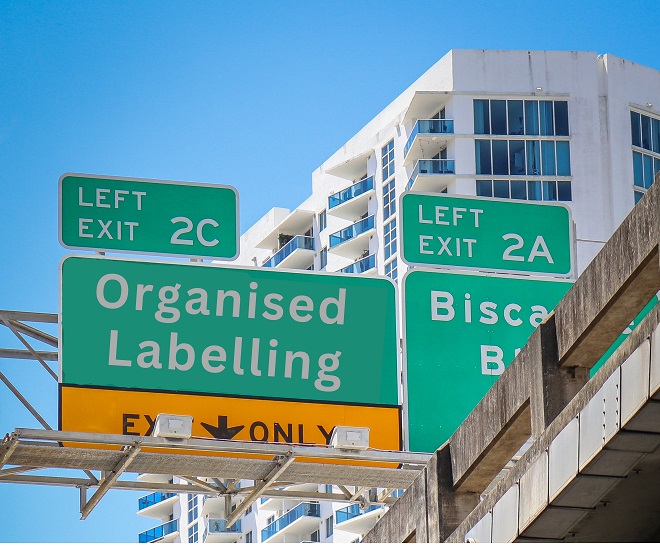
Destination: Organised Labels
As the head of operations, labels are a small, but critical part of your operation. If labels are causing you a headache in – let me help guide you through optimising your labelling – build a fast and efficient labelling system that you can be proud of. Imagine a labelling system that’s efficient and accurate. A system that takes data from your ERP system and produces labels with barely any human input. Labelling that’s efficient and easy.
Let’s look at how we can improve your label printing process.
The first step in optimising your label workflow is assessing and evaluating your existing labelling system.
Do you have any obvious improvements you can make?
Where are you encountering errors and problems?
What parts of your system are slow and tedious?
Are there points at which data needs to be entered?
Which areas could potentially stop your operations?
Getting a picture of the hardware and systems you use will also help set the scene. What information feeds into your labels and where is that information coming from. Assessing your labelling involves studying work and data flows. The study will involve talking to your team and mapping your labelling system.
We’ve got a whole set of questions that you can download here. Answer what you can and send it back to us here for advice.
Streamlining Label Creation and Design.
Do your labels have to meet all of the needs of the stakeholders needs in your organisation?
Is marketing happy with each consumer facing label design?
Do your labels meet all of the regulatory requirements?
Could you use your labels to build engagement with customers?
Who designs labels in your organisation? Are there multiple people?
Are there label design guidelines to help designers?
Are your labels clear and consistent across the range of designs?
Do you have software that maintains the central library of label designs?
Next Steps to Creating Optimised Labelling
Labelling operations, even in a small organisation with a handful of printers, can become complex. When labels, ribbons, hardware, maintenance, software, data management and training are considered, the complexity soars.
The more complex a process is, the greater scope there is for inefficiencies.
We are here to help. If you have a question, or you would like a would like to discuss with us, please get in touch. Email sales@expertlabels.co.uk or call us on 01359 271 111, we’d love to hear from you.
Useful Links
GS1: An international non-profit organisation that develops and maintains global standards for product identification, including barcoding and labelling.
Essential cookies enable basic functions and are necessary for the proper function of the website.
Name
Description
Duration
Cookie Preferences
This cookie is used to store the user's cookie consent preferences.
30 days
Google Tag Manager simplifies the management of marketing tags on your website without code changes.
Name
Description
Duration
cookiePreferences
Registers cookie preferences of a user
2 years
td
Registers statistical data on users' behaviour on the website. Used for internal analytics by the website operator.
session
Statistics cookies collect information anonymously. This information helps us understand how visitors use our website.
Name
Description
Duration
tk_tc
WordPress.com analytics cookie used to track user consent and cookie preferences
Session
tk_ro
WordPress.com analytics cookie used to track returning visitors
12 months
tk_rl
1 day
tk_ai
WordPress.com analytics cookie used to track unique visitors
12 months
expertlabels-_zldt
1 day
expertlabels-_zldp
WooCommerce SourceBuster cookie used for order attribution and tracking visitor source
1 years
_hjTLDTest
Session
_hjSessionUser_493747
12 months
_hjSession_493747
Hotjar session tracking cookie
30 minutes
SourceBuster is used by WooCommerce for order attribution based on user source.
Name
Description
Duration
sbjs_session
The number of page views in this session and the current page path
30 minutes
sbjs_udata
Information about the visitor’s user agent, such as IP, the browser, and the device type
session
sbjs_first
Traffic origin information for the visitor’s first visit to your store (only applicable if the visitor returns before the session expires)
session
sbjs_current
Traffic origin information for the visitor’s current visit to your store
session
sbjs_first_add
Timestamp, referring URL, and entry page for your visitor’s first visit to your store (only applicable if the visitor returns before the session expires)
session
sbjs_current_add
Timestamp, referring URL, and entry page for your visitor’s current visit to your store
session
sbjs_migrations
Technical data to help with migrations between different versions of the tracking feature
session
Marketing cookies are used to follow visitors to websites. The intention is to show ads that are relevant and engaging to the individual user.
Facebook Pixel is a web analytics service that tracks and reports website traffic.